Choosing the best power banks for iPhone and Android is less about buying the biggest mAh number and more about matching capacity, charging speed, compatibility and size to the devices you actually carry. This guide explains what to check before buying, without pretending to have lab-tested individual models.
Last updated: October 2026. Wireless-charging standards and device compatibility can change, so check the manufacturer’s specifications before buying.
Quick Answer: What Makes a Good Power Bank?
| Need | What to look for | Why it matters |
|---|---|---|
| Everyday phone backup | 5,000–10,000mAh | Smaller and easier to carry |
| Travel or multiple devices | 10,000–20,000mAh | More energy for phones, tablets and accessories |
| Fast wired charging | USB-C PD, with PPS when supported | Better compatibility with modern phones and some laptops |
| Magnetic wireless charging | Qi2 certification and compatible phone/case | Better alignment and standards-based interoperability |
Capacity: 5,000mAh vs 10,000mAh vs 20,000mAh
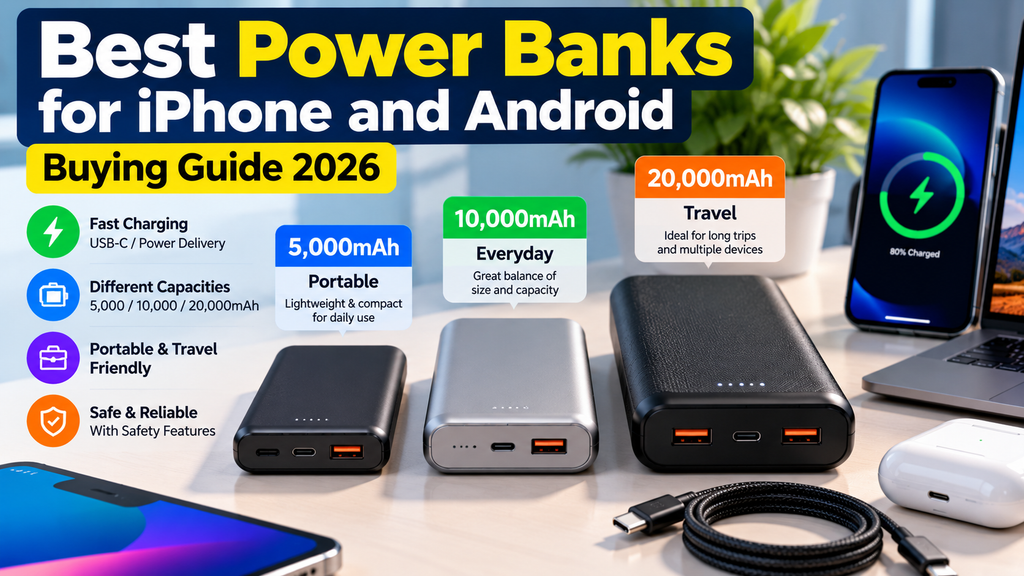
A 5,000mAh power bank is mainly about portability. It can be useful for an emergency top-up when you do not want a heavy bag. A 10,000mAh model is a practical middle ground for many phone users. A 20,000mAh model makes more sense for longer trips or people carrying several devices, but it is larger and heavier.
Do not expect the number printed on a power bank to equal the exact charge your phone receives. Conversion losses, voltage differences, cable quality and the phone’s charging system all affect usable energy. Compare products using the manufacturer’s rated specifications rather than assuming a simple mAh-to-mAh calculation.
Wired Charging: USB-C PD and PPS
For most buyers, USB-C wired charging should be the first thing to check. USB Power Delivery lets the charger and device negotiate an appropriate power level. USB-IF says USB PD 3.1 supports power levels up to 240W with suitable USB-C cables and devices, although most phones need far less.
PPS, or Programmable Power Supply, can matter for compatible phones because it allows more flexible voltage control. The important point is simple: do not buy based only on a headline wattage. Check whether the power bank supports the charging protocol your phone actually uses.
Qi2 and Magnetic Power Banks
Qi2 is the standards-based option to look for if you want magnetic wireless charging. The Wireless Power Consortium says Qi2 introduced 15W charging with magnetic alignment, while Qi2 25W is the newer higher-power version. Certification matters because it provides a way to verify safety and interoperability.
Compatibility is still device-specific. A phone may support ordinary Qi wireless charging without supporting magnetic Qi2 attachment. Samsung’s current guidance, for example, distinguishes Qi-compatible Galaxy phones from newer Qi2-supported devices and cases. Always check the exact phone and case combination before buying a magnetic power bank.
Ports and Multi-Device Charging
A power bank with several ports can be more useful than one with a higher headline wattage. Check how much power is available when two or more ports are used at the same time. A product may advertise a high maximum output but divide that power between devices.
- USB-C: Prefer this for modern phones, tablets and compatible laptops.
- USB-A: Useful if you still carry older cables or accessories.
- Built-in cable: Convenient, but check the connector and replacement situation.
- Display: Helpful if you want an exact battery percentage instead of four LED dots.
Safety and Quality Checks
Power banks contain rechargeable lithium-ion cells, so safety should matter more than a flashy specification. Buy from a known manufacturer or retailer, check the stated protections and warranty, and avoid damaged or swollen batteries. Do not leave a damaged power bank in service simply because it still appears to charge.
For wireless charging, look for recognised Qi or Qi2 certification where applicable. The Wireless Power Consortium maintains a certification database, while device manufacturers publish their own compatibility requirements.
How to Choose the Right Power Bank
- Start with your device. Check its maximum wired and wireless charging specifications.
- Choose capacity. Pick 5,000mAh for light emergency use, 10,000mAh for everyday carry, or 20,000mAh for longer trips and multiple devices.
- Check the protocols. Look for USB-C PD and, where relevant, PPS or Qi2.
- Check simultaneous output. Make sure the power split works for your devices.
- Check size and weight. A power bank that stays at home because it is too heavy is not a useful travel accessory.
- Check safety, warranty and certification. These matter more than a slightly higher capacity number.
Best Type by User
| User | Best starting point |
|---|---|
| Phone-only commuter | Compact 5,000–10,000mAh USB-C model |
| Frequent traveller | 10,000–20,000mAh model with USB-C PD |
| Magnetic-charging user | Qi2-certified model compatible with the phone/case |
| Phone + tablet user | Higher-capacity model with enough USB-C output |
| Phone + laptop user | Check the laptop’s required wattage before choosing the power bank |
Common Buying Mistakes
- Choosing only by mAh.
- Assuming every USB-C port supports the same charging speed.
- Ignoring power sharing when multiple devices are connected.
- Assuming magnetic attachment means Qi2 certification.
- Buying a very large power bank that is inconvenient to carry.
- Ignoring warranty, certification and battery safety information.
Frequently Asked Questions
Is 10,000mAh enough for a phone?
For many users, 10,000mAh is a useful everyday capacity. The actual number of phone recharges depends on the phone battery, conversion losses and charging conditions.
Is a 20,000mAh power bank better?
It is better when you need more stored energy, such as during travel or when charging several devices. It is not automatically better if portability is your priority.
Is Qi2 better than ordinary wireless charging?
Qi2 adds standards-based magnetic alignment and interoperability features. Whether it is better for you depends on whether your phone and case support it and whether you value magnetic charging.
Can a power bank charge a laptop?
Some can. Check the laptop’s USB-C charging requirements and the power bank’s supported output. A high-capacity battery alone does not guarantee laptop compatibility.
Best Power Banks for iPhone and Android: How Much Power Do You Really Need?
For most everyday users, a 10,000mAh power bank is the best balance between useful backup power and portability. It is easier to carry in a pocket or small bag and is usually enough for a typical day away from a charger. A 20,000mAh model makes more sense when you travel frequently, use a phone heavily, or need to recharge more than one device.
Do not compare capacity alone. A good power bank should also provide an appropriate USB-C output, reliable power delivery, compatibility with your phone, and sensible safety protections. If you use an iPhone with a magnetic charging setup, Qi2 compatibility can make wireless charging more convenient, while Android users should pay particular attention to USB-C PD and PPS support where their phone supports those standards.
Best Power Banks for iPhone and Android: Check Compatibility
Before buying, check your phone’s charging requirements and the power bank’s output specifications. A higher advertised wattage does not automatically mean faster charging if the phone cannot accept it. For multiple devices, also check whether the listed output is available when two or more ports are used at the same time. These details can make a bigger difference in daily use than a larger battery number.
The capacity printed on a power bank is only one part of the buying decision. Think about how you normally use it: a commuter who needs a short top-up may value a smaller 10,000mAh power bank, while a traveller carrying a phone, earbuds and tablet may prefer 20,000mAh. More capacity usually adds weight and bulk, so the best choice is the smallest capacity that comfortably covers your routine.
Charging speed matters just as much. A power bank with USB-C PD can be more useful than a higher-capacity model with slow output. If your phone supports PPS, check for PPS support as well. For magnetic charging, look for a certified Qi2 power bank and confirm that the phone and case support the standard. Also check the output available when multiple devices are connected, because the advertised maximum may not be available to every port at the same time.
What to Check Before You Buy
- Capacity: Match 5,000mAh, 10,000mAh or 20,000mAh to your typical charging needs.
- Output: Check USB-C PD wattage and supported charging protocols.
- Compatibility: Confirm your phone, case, cable and wireless standard are supported.
- Multi-device use: Check the power split when more than one device is connected.
- Portability: Compare dimensions and weight, not just battery capacity.
- Safety: Buy from a reputable source and check warranty and protection specifications.
Final Verdict
The best power bank is the one that matches your devices and your daily routine. For most phone users, start with a compact 10,000mAh USB-C model. Move to 20,000mAh when travel or multiple devices justify the extra size. If magnetic charging matters, look for Qi2 certification and verify compatibility with the exact phone and case.
Quick Buying Checklist for 2026
- Choose 5,000mAh for occasional emergency charging, 10,000mAh for everyday carry, or 20,000mAh for travel and multiple devices.
- Check the actual USB-C PD output, not just the total wattage printed on the box.
- For magnetic charging, confirm Qi2 certification and compatibility with your exact phone and case.
- Compare weight and dimensions before buying; higher capacity usually means a larger battery.
- Check warranty, safety protections and the manufacturer’s specifications before purchase.
If you are also planning a laptop upgrade, see our Laptop Buying Guide 2026. For more mobile-focused recommendations, browse our AI Apps for Android and iPhone guide.