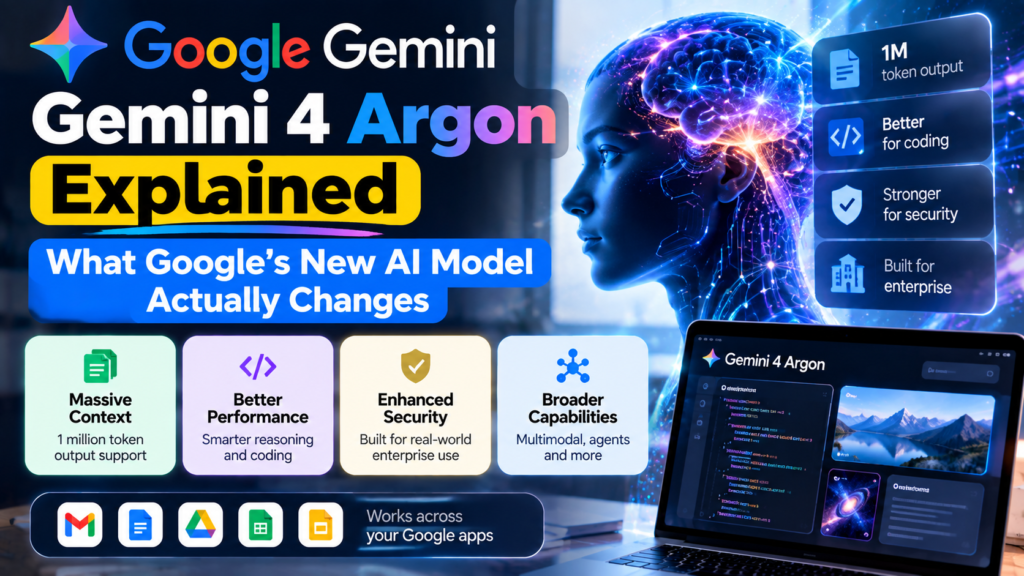
Google has introduced Gemini 4 Argon, a new frontier AI model designed for complex, long-running work across software engineering, enterprise knowledge work and cybersecurity defense. Unlike a typical consumer chatbot launch, Argon is being released in phases, with early access focused on trusted cyber defenders while Google strengthens its safety controls.

What is Gemini 4 Argon?
Gemini 4 Argon is Google’s latest frontier model for difficult, multi-step workloads. Google says it is designed to sustain deeper reasoning across long-horizon tasks rather than focusing only on short conversational answers.
The model is aimed at areas such as software engineering, financial and legal knowledge work, research, and cybersecurity defense. Google is currently rolling it out to a limited group of trusted cyber defenders through its Fairwind Program before broader availability.
Why Gemini 4 Argon matters
The important change is not simply that Google has released another larger AI model. Argon is designed around tasks where an AI system may need to reason through many steps, inspect substantial context, use tools and produce a result that requires review.
- Long-horizon reasoning: Google says Argon is built for complex workflows that require sustained reasoning.
- Software engineering: It is being used for debugging, code migrations and optimization work.
- Knowledge work: Google highlights legal, finance and research-oriented workloads.
- Multimodal understanding: The model can work with visual information, documents and long videos.
- Cybersecurity defense: Argon is designed to find, validate and patch software vulnerabilities in defensive settings.
The 1-million-token output limit
One of Argon’s headline specifications is an industry-leading 1-million-token output limit, according to Google. The company says this is intended to give the model more room to reason and generate results during complicated tasks.
A larger output limit does not mean every answer will use anywhere near one million tokens. In practical use, the useful advantage is the additional headroom available for workflows involving large amounts of reasoning, code or other generated material.
Gemini 4 Argon for coding
Google says its engineers are already using Argon for everyday debugging, algorithm design and large-scale codebase migrations. One example involves work migrating C and C++ codebases toward Rust.
Google also reports strong results on its selected software-engineering evaluations. These are company-reported benchmark results, so they should be treated as indicators rather than proof that Argon will outperform every model for every coding task.
Cybersecurity is a major focus
Cybersecurity is one of the most distinctive parts of the Argon announcement. Google says the model can autonomously find, validate and patch critical software vulnerabilities in defensive environments.
Google says Argon is currently being provided to trusted defenders and internal teams with safeguards designed specifically for high-risk capabilities. The company is also working through a U.S. government voluntary pre-release model access process as it expands access.
For ordinary users, the key takeaway is not that Argon is a cybersecurity tool they should immediately use. It is that frontier AI is increasingly being developed for defensive security work that previously required specialist teams and tooling.

What can Gemini 4 Argon do?
| Area | What Google highlights |
|---|---|
| Software engineering | Debugging, code migration, optimization and complex engineering workflows. |
| Finance and legal work | Multi-step research, analysis and drafting workflows. |
| Cybersecurity | Vulnerability discovery, validation and defensive patching. |
| Research | Deep reasoning across large and complex information sets. |
| Multimodal tasks | Visual understanding, chart analysis and long-video understanding. |
How much does Gemini 4 Argon cost?
Google says Argon will launch at an introductory API price of $2 per million input tokens and $10 per million output tokens, with cached input tokens priced at a 95% discount from the input-token rate.
After the introductory period, Google says the price will increase to $4 per million input tokens and $20 per million output tokens.
These are API pricing figures, not the price of a consumer Gemini subscription. Broader consumer access is planned but is not yet generally available at the time of Google’s announcement.
When will Gemini 4 Argon be available?
Argon is not yet a normal, open consumer model. Google says it is first rolling out to trusted cyber defenders through the Fairwind Program, with broader access planned for developers, enterprises and consumers later.
Google says the first broader groups will include paid API customers and Google AI Ultra subscribers. The exact availability can vary by account, product and region, so users should check Google’s current documentation rather than relying on an old announcement date.
Gemini 4 Argon vs a normal AI chatbot
The easiest way to understand Argon is to think about the type of work it is designed to handle. A normal chatbot can answer questions, summarize text or help draft content. Argon is being positioned for workflows where the system needs to work through a much longer chain of reasoning and handle substantial context.
That does not make it automatically better for every everyday task. For a short email, simple question or quick rewrite, a faster and less expensive model may be the more practical choice.
What about AI agents?
Argon’s long-horizon capabilities are closely related to the direction of AI agents. Agents need models that can maintain context, reason through multiple steps and interact with tools while staying within defined boundaries.
Google’s announcement also emphasizes safeguards against prompt injection and unwanted behavior. That matters because increasingly capable models can create larger consequences when connected to software, files or external systems.
Should consumers be excited about Gemini 4 Argon?
Yes, but there is no need to treat Argon as an immediate replacement for the Gemini model you already use. Its initial release is focused on demanding professional and defensive workloads, and broad consumer access is still being phased in.
The bigger story is the direction of AI development: models are moving from answering isolated questions toward handling longer, more complex workflows. If that trend continues, future consumer assistants should become better at completing multi-step tasks rather than simply generating individual responses.
What Google says about safety
Google says it is strengthening safeguards before broad release, including protections against misuse, prompt injection and model behavior that could go beyond a user’s intended goal.
This is particularly important for cybersecurity-capable models. More capable defensive systems can also create higher risks if misused, which is one reason Google is using a phased rollout rather than immediately releasing every capability to everyone.
Frequently asked questions
Is Gemini 4 Argon available to everyone?
No. Google is currently rolling it out in phases, beginning with trusted cyber defenders and selected testers.
Is Gemini 4 Argon free?
There is no general free consumer version at launch. Google has published API pricing and says broader access will expand over time.
Is Argon better than every other AI model?
No model is best at everything. Google’s benchmark results show strong performance in selected areas, but real-world performance depends on the task, tools, context, cost and latency.
Why is cybersecurity such a big part of the launch?
Google says Argon can autonomously identify, validate and patch vulnerabilities in defensive settings. That capability is powerful enough to require additional safeguards and controlled access.
Final verdict
Gemini 4 Argon is significant because Google is positioning it as a model for difficult, long-running work rather than just another general chatbot upgrade. Its 1-million-token output limit, coding capabilities, enterprise focus and cybersecurity work show where frontier AI is heading.
For most people, the practical impact will come later as these capabilities reach consumer products and developer tools. For now, Argon is best viewed as an early look at a more capable generation of AI systems that can reason through much larger workflows.