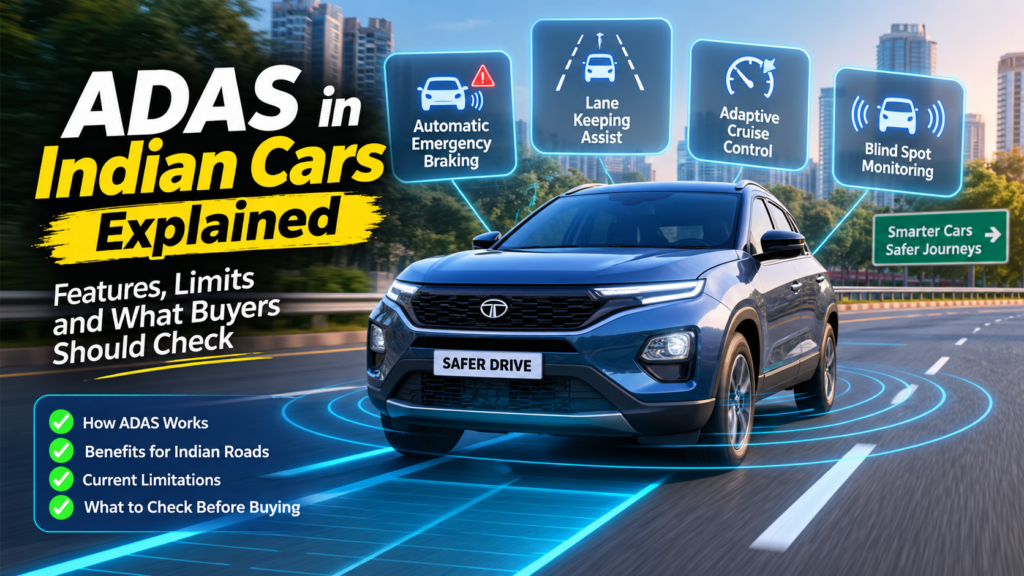
Advanced Driver Assistance Systems (ADAS) use cameras, radar and other sensors to help drivers detect hazards and manage specific driving tasks. They can make some journeys safer and less tiring, but they do not turn a car into a self-driving vehicle. For buyers comparing ADAS in Indian cars, the important question is not simply whether a car advertises the technology; it is which functions are included, how they behave in local conditions and whether the driver understands their limits.
What ADAS actually means
ADAS is a group of separate assistance features. A car may offer only a few of them, and names can vary by manufacturer. Some systems warn the driver, some briefly intervene, and others control speed or steering within defined limits. Always check the feature list for the exact variant rather than relying on a model name or a general brochure headline.
Common ADAS features explained
Forward collision warning and automatic emergency braking
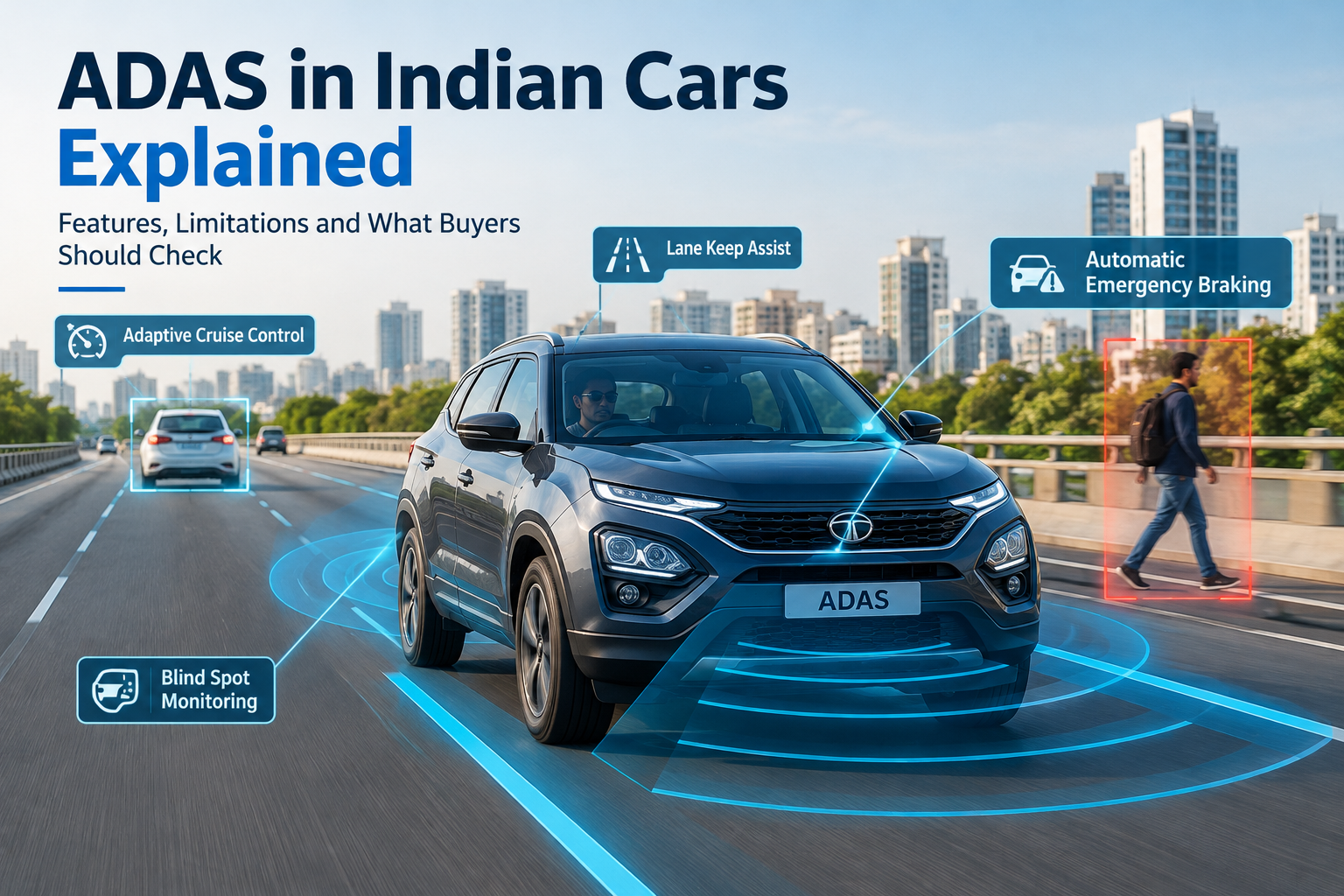
Forward collision warning alerts the driver when the system estimates that a collision with a vehicle or obstacle ahead may be imminent. Automatic emergency braking (AEB), when fitted and operating within its design limits, may apply the brakes if the driver does not respond in time. Detection ability varies by system: some can recognise vehicles, while others may also detect pedestrians or cyclists under specific conditions. Do not assume every AEB system supports every road user or works at every speed.
Lane departure warning and lane keeping assistance
Lane departure warning alerts the driver when the car appears to drift out of a detected lane without an indicated manoeuvre. Lane keeping assistance may apply a corrective steering input. Camera-based systems need visible lane markings and can be affected by faded paint, road repairs, glare, rain or confusing temporary markings. On roads where lane markings are inconsistent, drivers should expect warnings or interventions to be limited.
Adaptive cruise control
Adaptive cruise control can maintain a selected speed and, in supported conditions, adjust it to keep a following gap behind a vehicle ahead. Some versions can slow the car substantially; others have narrower operating limits. It does not remove the need to watch traffic, anticipate cut-ins or take control when the system asks.
Blind-spot monitoring and rear cross-traffic alert
Blind-spot monitoring warns about vehicles detected beside or just behind the car. Rear cross-traffic alert can warn about traffic approaching from the sides while reversing. Sensor coverage is not unlimited, and a warning may not cover pedestrians, two-wheelers or objects in every situation. Mirrors, shoulder checks and careful reversing remain essential.
ADAS in Indian cars: why road conditions matter
Indian driving environments can change quickly: lane markings may disappear, two-wheelers may pass through narrow gaps, traffic can cut in at short notice, and construction zones can alter road layouts. Dust, heavy rain, direct sunlight, dirty windshields, stickers near camera areas and blocked sensors can also reduce system performance. These conditions do not mean ADAS is useless; they mean its performance depends on the design, calibration and environment.
Read the owner’s manual for operating-speed ranges, weather limitations, sensor-cleaning instructions and dashboard warnings. If the vehicle has had a windscreen replacement, front-end repair or wheel alignment, ask the authorised service centre whether camera or radar calibration is required.
ADAS is not autonomous driving
Marketing labels can make assistance features sound more capable than they are. Most consumer ADAS functions require continuous driver supervision. The driver remains responsible for speed, safe following distance, lane choice, checking mirrors and responding to hazards. Never use a phone, read messages or relax attention because cruise control or lane assistance is active.
ADAS in Indian cars: what to check before buying
- Variant-level feature list: Confirm which systems are fitted to the exact trim and whether they are standard or optional.
- Operating limits: Ask about speed ranges, road types, weather conditions and the situations in which each feature may disengage.
- Real demonstration: During a safe dealer demonstration, learn how alerts sound, what steering or braking intervention feels like and how to override the system. Do not test emergency features in live traffic.
- Driver monitoring: Understand how the car checks driver attention and what happens if the driver ignores repeated warnings.
- Service and calibration: Ask how sensors are calibrated after repairs and whether calibration adds time or cost to maintenance.
- Tyres and visibility: Remember that assistance systems cannot compensate for worn tyres, poor visibility or unsafe speed.
- Local usability: Read owner feedback about false alerts and lane detection in the types of roads you regularly use, while treating anecdotes as supporting evidence rather than proof.
Questions worth asking the dealer
Ask which sensors the vehicle uses, whether AEB detects pedestrians and cyclists, whether adaptive cruise control can stop and restart in traffic, how lane assistance behaves when markings disappear, and which functions can be adjusted or switched off. Request a demonstration of the dashboard indicators and ask where the sensors are located so you can keep them clean.
Bottom line
ADAS can provide valuable warnings and assistance, but its value depends on the specific functions, their operating limits and the driver’s understanding. Compare the exact variant, learn the manual and test the interface safely. Choose these systems as an extra layer of assistance—not as a replacement for attentive driving.
Frequently asked questions about ADAS
Is ADAS the same as self-driving?
No. Most consumer ADAS features provide warnings or limited steering and braking assistance. The driver must remain attentive and responsible for controlling the vehicle.
Does ADAS work reliably on every Indian road?
No system works in every condition. Faded lane markings, heavy rain, glare, dust, roadworks and unpredictable traffic can affect some functions. Check the owner’s manual for the limits of the specific vehicle.
Should I pay extra for ADAS?
It depends on the exact features, how well they work for your regular routes and the price difference between variants. Test the interface safely, review the manual and compare the whole vehicle rather than choosing based on an ADAS label alone.
Does ADAS reduce the need for a test drive?
No. A test drive remains useful for assessing visibility, braking feel, seating position, mirrors and the clarity of alerts. Ask the dealer to demonstrate the assistance features in a safe, controlled way.
Related FutureGearAI guides
- AMT CNG Cars in India: What to Check Before Buying — compare practical ownership and buying considerations.
- Petrol vs Diesel vs CNG vs Hybrid vs EV: 2026 Guide — review powertrain choices before selecting a car.
- EV Charging in India: Why Reliability Matters — understand another part of the changing vehicle technology landscape.
How to judge ADAS in everyday Indian driving
The usefulness of ADAS depends on your routine, not only the number of features listed in a brochure. If you frequently drive on expressways, adaptive cruise control and forward collision alerts may help reduce workload when used correctly. In dense city traffic, frequent cut-ins, motorcycles moving between lanes and inconsistent lane markings can make some functions less predictable. This is why a controlled demonstration and a careful reading of the manual matter.
Consider three everyday situations:
- Expressway travel: Learn the following-distance settings and how the system responds when another vehicle cuts in. Keep your hands ready and eyes on the road.
- City roads: Expect lane assistance to be limited where markings are faint or interrupted. Never rely on it to steer around parked vehicles, potholes or roadworks.
- Rain, dust and repairs: Keep the windshield and sensor areas clean. If a warning appears after a repair or windshield replacement, ask an authorised workshop whether inspection or recalibration is needed.
Also check how clearly the vehicle explains system status. A good interface should make it easy to tell when assistance is active, temporarily unavailable or asking you to take over. If alerts are confusing during the test drive, ask the dealer to explain them before you decide. The aim is to understand the feature’s limits in advance, rather than discovering them in a stressful moment.
Practical ADAS buyer checklist for Indian cars
Before choosing ADAS in Indian cars, compare the exact variant and try the controls during a safe test drive. Use this quick checklist to make the comparison practical. These checks help you judge whether the ADAS features in Indian cars suit your regular routes and driving conditions:
- Confirm the exact functions included on the variant, not just the model range.
- Ask whether automatic emergency braking detects pedestrians and cyclists, and learn its speed limits.
- Check whether adaptive cruise control can bring the car to a stop and what the driver must do next.
- Find out how lane assistance behaves when markings are faded, diverted or temporarily missing.
- Ask the service centre about camera and radar calibration after a windscreen replacement, collision repair or alignment work.
- Locate the sensors and read the cleaning instructions so dirt, stickers or accessories do not obstruct them.
- Compare the extra cost with the features you will actually use; ADAS does not replace careful driving.
For authoritative details, read the Global NCAP vehicle-safety information and the NHTSA guide to driver-assistance technologies. Always confirm the limits of your own car in its manufacturer’s owner’s manual.
Editorial note: Features differ by manufacturer, model year and variant. Verify specifications and limitations in the official brochure and owner’s manual before making a purchase decision.