The Shift Indian Personal Mobility Landscape
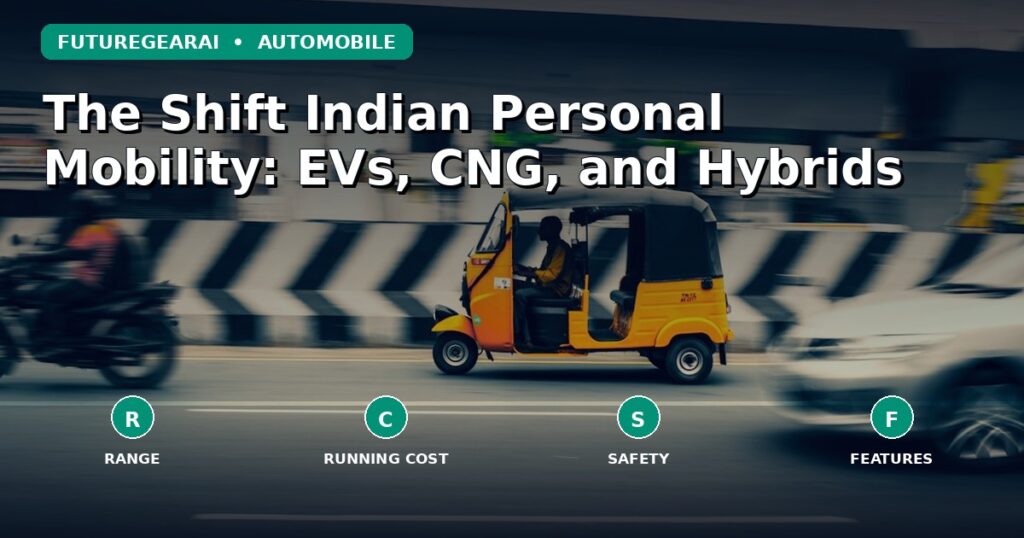
The Shift Indian Personal mobility landscape is currently undergoing a major transformation. For the first time in history, vehicles powered by alternative fuels—including CNG, hybrids, and electric vehicles (EVs)—have collectively outsold traditional petrol-powered cars. This data comes from the Federation of Automobile Dealers Associations (FADA) report for August 2026. It highlights a structural change in how Indian consumers approach daily driving. While concerns regarding E20 ethanol-blended petrol have played a role, the primary drivers remain the search for lower running costs and the availability of diverse powertrain options.
This milestone reflects broader economic and environmental pressures facing urban and semi-urban Indian consumers. Fuel price volatility and stricter emission norms, such as the real driving emissions (RDE) phase-two standards, have forced buyers to look beyond conventional internal combustion engines. Automakers have responded by pivoting their manufacturing lines. They are now accommodating multiple alternative fuel pathways simultaneously rather than betting solely on a single technology.
Shift Indian Personal: Evaluating Running Costs and Convenience
When selecting a vehicle for daily driving, the choice between EV and CNG often boils down to your specific access to infrastructure. If you can charge at home or your workplace, an EV typically offers the lowest cost per kilometer. The absence of a traditional gearbox in EVs provides a smooth, linear power delivery. This is particularly advantageous in dense city traffic. However, this convenience is contingent on your charging setup. If you lack a reliable, dedicated charging point, the EV experience can become a source of anxiety rather than efficiency.
Energy consumption metrics also differ notably. An electric hatchback operating in stop-and-go urban gridlock utilizes regenerative braking to recapture kinetic energy. This reduces energy waste compared to a traditional idling ICE engine. EV battery degradation is a factor over long ownership cycles. However, modern thermal management systems and chemistry improvements, such as Lithium Iron Phosphate (LFP) cells, have mitigated rapid degradation concerns in Indian ambient temperatures.
Conversely, CNG vehicles remain a pragmatic choice for many, though they introduce their own set of trade-offs. While CNG fuel costs are significantly lower than petrol, the experience is marred by the potential for queues at refueling stations. Manufacturers like Tata have innovated with twin-cylinder layouts to preserve boot space. Despite this, the physical storage capacity in most CNG vehicles remains compromised compared to their pure ICE or EV counterparts.
Infrastructure and Accessibility Realities
The charging ecosystem for EVs is expanding. Companies like ThunderPlus and major manufacturers like Hyundai are investing in fast-charging networks. Hyundai has committed to installing 600 public fast chargers across India over the next several years. This builds upon an existing management system that supports over 14,000 charge points. These high-capacity chargers, often 120 kW and above, are designed to accommodate larger battery packs, reducing the time required to regain range.
Despite this expansion, geographic disparities persist. Tier-1 cities boast relatively dense clusters of fast chargers. Tier-2 and Tier-3 highway corridors often suffer from maintenance downtime, unmapped locations, or lack of payment interoperability. This makes long-distance touring via EV a calculated endeavor requiring dedicated route-planning applications. For commercial fleet operators, companies like ThunderPlus are attempting to bridge this gap. They are deploying universal chargers that handle two-wheelers, three-wheelers, and four-wheelers under one roof, though rural availability remains uneven.
CNG infrastructure is more established in many urban centers. However, it is not immune to the pressures of high demand. As rural penetration for CNG grows—noted at 15% recently—the pressure on existing pumps in metropolitan areas continues to fluctuate. Buyers must consider their local route’s proximity to both charging hubs and CNG stations before finalizing a purchase.
Practical Trade-offs for Daily Commuters
Beyond fuel, the ownership experience differs significantly. Maintenance costs and long-term reliability are key factors. For example, the 2026 Tata Tiago range offers petrol, CNG, and EV versions. This allows for a direct comparison of features. While the EV version benefits from software updates for better range prediction and often includes lifetime battery warranties for the first owner, the CNG variants rely on established mechanical systems. Many local mechanics are already familiar with these systems.
Hybrid vehicles offer a compelling middle ground by eliminating external charging requirements altogether. Strong hybrids utilize an integrated starter generator and battery pack to capture energy during deceleration. This allows the vehicle to run on electric power for extended periods at low city speeds. However, the upfront acquisition cost of a strong hybrid is typically higher than its pure petrol or entry-level CNG counterpart. This requires high annual mileage to offset the initial price premium.
Powertrain Comparison in Urban Traffic
Navigating daily urban gridlock exposes distinct operational characteristics across alternative powertrains. In a pure electric vehicle like the Tata Punch EV, the instant torque delivery combined with a single-speed direct drive mechanism eliminates gear-shifting jerks entirely. This provides an effortless driving experience in congested stop-and-go traffic where conventional manual or automated manual transmissions (AMTs) frequently hunt for gears.
On the other hand, factory-fitted CNG variants—while economical—often pair their fuel systems with manual gearboxes or entry-level AMTs. While automated manual transmissions remove the physical labor of clutch operation, they can sometimes exhibit noticeable pauses during shifts. Drivers transitioning from traditional automatics may find these mechanical shifts less seamless than the continuous power flow of an EV. However, they offer a familiar driving dynamic for those accustomed to manual cars.
The E20 Factor and Consumer Sentiment
Consumer behavior in India’s passenger vehicle market is increasingly influenced by fuel quality updates. The transition toward E20 petrol—fuel blended with 20 percent ethanol—has introduced concerns among motorists. These include long-term component compatibility and potential drops in real-world fuel efficiency. Industry bodies like FADA have noted that while E20-related anxiety initially accelerated the movement away from standard petrol cars, the sustained growth of alternative fuels is primarily supported by the tangible savings offered by CNG and the improving maturity of EV options. These practical details are useful when evaluating Shift Indian Personal against the reader’s actual needs.
This sentiment has prompted manufacturers to diversify their lineups rapidly. Rather than relying on a single alternative, brands are building comprehensive multi-fuel portfolios. This structural shift means that buyers are no longer evaluating vehicles solely on upfront purchase price. They are factoring in long-term fuel regulatory changes, urban emission zones, and running costs over a 5-to-10-year ownership horizon.
Comparison Checklist for Daily Drivers
- Charging/Refueling Access: Do you have a private charging point, or is there a CNG station on your daily route?
- Boot Space Requirements: Does the CNG cylinder installation limit your utility for weekend travel?
- Transmission Preference: Are you comfortable with the characteristics of an AMT often found in budget CNG cars, or do you prefer the seamless nature of an EV?
- Annual Usage: High-mileage users often benefit more from the lower per-km cost of EVs, provided they can manage the charging time.
- Resale Value Projections: Consider how technological obsolescence may impact the secondary market for early-generation EVs versus mechanically simple CNG vehicles.
Frequently Asked Questions (FAQ)
1. Are EVs truly cheaper to maintain than CNG cars in India?
Yes, in terms of routine service, EVs require fewer moving parts. There are no engine oil changes, spark plugs, or clutch replacements. However, unexpected out-of-warranty battery repairs can be expensive. Checking manufacturer warranty terms is critical.
2. How does E20 fuel impact existing petrol cars?
E20 petrol can cause compatibility issues and minor reductions in fuel efficiency for older cars not engineered for high ethanol content. This has accelerated buyers’ moves toward dedicated alternative powertrains like CNG and EVs.
3. Do CNG cars suffer from power loss on inclines?
Traditional single-cylinder CNG setups often experienced a noticeable drop in power when climbing steep gradients. Modern factory-fitted sequential injection systems and twin-cylinder configurations have largely minimized this issue. Drivers may still need to downshift earlier than in petrol modes.
Closing Thoughts on Future Mobility
The market is no longer a binary choice between petrol and diesel. Manufacturers are diversifying their portfolios. Hyundai, for example, has announced a roadmap for 26 new models through FY2030, including a mix of EVs, hybrids, and internal combustion engines. This suggests that the ‘best’ choice is increasingly dependent on the specific use case rather than a one-size-fits-all solution.
For the daily commuter, the decision should be dictated by infrastructure availability. If you can eliminate the need for public charging infrastructure through home or office installation, the EV becomes the superior choice for urban smoothness and operational economy. If your driving patterns are erratic or you frequently travel to areas where charging networks are sparse, the CNG vehicle remains a reliable bridge technology. This is provided you are willing to manage the logistical constraints of refueling.
Related FutureGearAI articles
Continue with these related articles for additional context: Navigating the 2026 Budget Electric Car Market · Home EV Charging Infrastructure in India: Beyond Public Networks
Sources & further reading
- Alternative-fuel cars outsell petrol cars in India for first time. What’s driving the shift? — Hindustan Times
- Hyundaiâs ambitious roadmap for India: 26 new models, EV push and charging network – The Times of India — Indiatimes
- ThunderPlus: Driving India’s EV Future — The New Indian Express
- My budget is ₹10–12 lakh (on-road), and I am looking for CNG or EV options because I want very good mileage for city driving. I can also wait until June if there are any upcoming car launches worth considering. Which car would you suggest? | Ask Autocar Anything | Autocar India — Autocar India