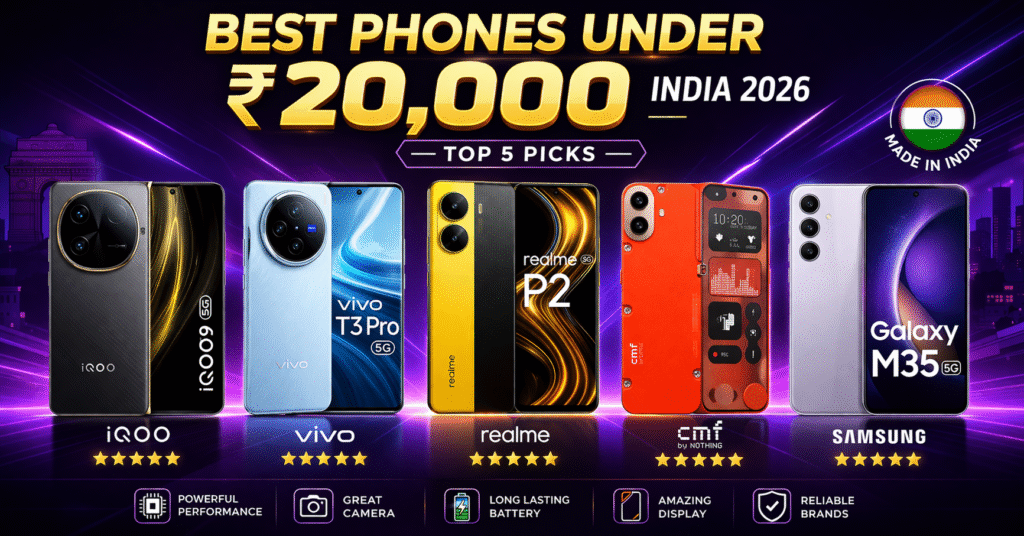
Buying a budget smartphone in India in 2026 is no longer just about finding the cheapest 5G phone. Phones in the ₹10,000–₹20,000 range now compete on displays, battery life, cameras, software support, storage and everyday performance. Current market listings show strong options across this range, but specifications can vary significantly between variants and sellers.
What Is a Budget Smartphone in India in 2026?
For this guide, the budget segment mainly covers phones below ₹20,000, with the most important value bands around ₹10,000–₹15,000 and ₹15,000–₹20,000. If you are comparing models across price bands, start with our smartphone buying guide for a broader checklist. The right price depends on your priorities. A student may value battery life and display quality, while a gamer may need a stronger chipset and faster storage.
1. Check the Processor Before the Camera
Performance should be one of your first checks. Look at the processor generation, CPU/GPU capability, RAM type and storage type rather than judging a phone by RAM capacity alone. A phone with 8GB RAM is not automatically faster than one with 6GB RAM if the processor and storage are weaker.
For everyday use, prioritize smooth app switching, reliable 5G performance and good power efficiency. If gaming is important, check sustained performance and thermal behaviour instead of relying only on benchmark numbers.
2. Don’t Buy a Phone Just Because It Has 5G
5G is increasingly common below ₹20,000, but the number of supported bands and the modem implementation still matter. Check whether the exact Indian variant supports the bands used by your network operator. Also consider Wi-Fi, Bluetooth, NFC if you need contactless features, USB capability and dual-SIM behaviour.
3. Display Quality Matters Every Day
A good display can make a budget phone feel much more expensive. Look at panel type, resolution, refresh rate, peak brightness and outdoor readability.
- 90Hz or 120Hz: useful for smoother scrolling and supported games.
- AMOLED: generally offers deeper blacks and stronger contrast.
- Brightness: particularly important if you use your phone outdoors.
- Resolution: Full HD+ is preferable when available at a similar price.
Don’t choose a phone solely because it advertises a high refresh rate. A bright, well-calibrated screen with good software can provide a better experience than a higher refresh-rate panel with poor visibility.
4. Camera: Look Beyond Megapixels
A 50MP or 200MP label does not guarantee better photos. Sensor size, image processing, stabilization, lens quality and the manufacturer’s camera software all affect results.
For most buyers, a good main camera is more useful than several low-quality auxiliary cameras. If you regularly shoot video, check stabilization and the maximum supported recording resolution. For a wider comparison of what to prioritize when buying a phone, see our smartphone buying guide.
5. Battery Life and Charging
Battery capacity is important, but efficiency matters too. A 6,000mAh phone is not automatically better than a 5,000mAh phone if its processor and display consume substantially more power.
Also check charging speed, whether the appropriate charger is included, and the manufacturer’s battery-health features. For buyers who keep phones for several years, battery replacement availability and service support can be more important than an extreme charging specification. For official information about Android security updates, see Google’s Android Security Bulletins.
6. Software Updates Can Decide Long-Term Value
Software support is one of the easiest specifications to overlook. Before buying, check the manufacturer’s stated Android version-upgrade and security-update policy for the exact model.
A slightly more expensive phone with longer support can be better value than a cheaper phone that stops receiving meaningful updates sooner. This is particularly important if you use banking, payment and work applications on your phone.
7. Choose the Right RAM and Storage
For a phone you expect to keep for several years, 6GB RAM is a practical starting point, while 8GB can provide more headroom for heavier multitasking. Storage is equally important because photos, videos and apps grow quickly.
- 128GB: a sensible minimum for many users.
- 256GB: worth considering for heavy photo, video or gaming use.
- microSD: useful when supported, but don’t assume every budget phone includes it.
Always verify the exact configuration. A model may be advertised from a low price while the 8GB/256GB version costs considerably more.
8. Build Quality, Protection and Service
Check the phone’s IP rating, screen protection, frame construction and warranty terms. An IP rating can provide useful protection against dust and water, but it does not mean the phone is waterproof in every situation.
Service availability is also important. Before buying an unfamiliar brand, check whether an authorized service centre is accessible in your city and how replacement parts are handled.
Best Budget Smartphones in India: Categories to Consider
| Buyer priority | What to prioritize |
|---|---|
| Everyday use | Balanced processor, 6GB+ RAM, good display and battery |
| Gaming | Strong chipset, fast storage, high-refresh display and cooling |
| Camera | Good main sensor, image processing and stabilization |
| Battery | Large battery, efficient chipset and dependable charging |
| Long-term use | Software support, 128GB+ storage and service availability |
What Phones Are Competitive Right Now?
Current October 2026 listings show a wide range of choices under ₹20,000. Current comparison lists include models such as the Realme P4x 5G, Motorola Moto G67 Power 5G, Samsung Galaxy M17 5G, Moto G96 and CMF Phone 2 Pro. The ₹15,000 segment is similarly competitive. Treat model recommendations as a snapshot because prices and availability change quickly.
Samsung’s India listings also show multiple Galaxy models positioned below ₹20,000, including the Galaxy A07 5G, A17 5G, F17 5G and M17 5G. Always verify the exact configuration and current price before ordering.
How to Get the Best Price
- Compare the same RAM/storage configuration across retailers.
- Check the final checkout price rather than the headline discount.
- Look for bank offers, exchange bonuses and no-cost EMI only if they genuinely reduce your cost.
- Check seller ratings, warranty and return conditions.
- Compare the current model with its previous generation before buying.
Online sale pricing can change quickly. A large percentage discount may simply return a phone to a more normal street price, so compare the actual final price with multiple current listings.
Common Mistakes to Avoid
- Buying based only on megapixels or RAM.
- Choosing an old flagship without checking software support.
- Ignoring storage capacity.
- Assuming every 5G phone supports every local band.
- Ignoring service-centre availability.
- Choosing the cheapest variant when it has inadequate RAM or storage.
Budget Smartphones in India 2026: Frequently Asked Questions
Is ₹15,000 enough for a good smartphone in India?
Yes. The ₹15,000 segment is highly competitive and includes phones with 5G, high-refresh displays, capable processors and large batteries. The best choice depends on which feature matters most to you.
Is 8GB RAM necessary?
Not for everyone. Six gigabytes can be sufficient for everyday use, while 8GB is useful if you multitask heavily, keep many apps open or want more headroom for long-term use.
Should I buy a 5G phone in 2026?
For a new phone that you plan to keep for several years, 5G is generally sensible. However, verify the supported bands and don’t sacrifice processor quality, battery life or software support just to get 5G.
What is more important: camera megapixels or processor?
For overall phone experience, processor performance, software optimization and storage are usually more important than a large megapixel number. Camera quality should be judged using the complete camera system.
Final Verdict
The best budget smartphone in India is not necessarily the phone with the longest specification sheet. Focus on the combination of processor, display, battery, camera quality, software support, storage and after-sales service. Because prices and models change frequently, recheck the exact variant and current street price immediately before buying.