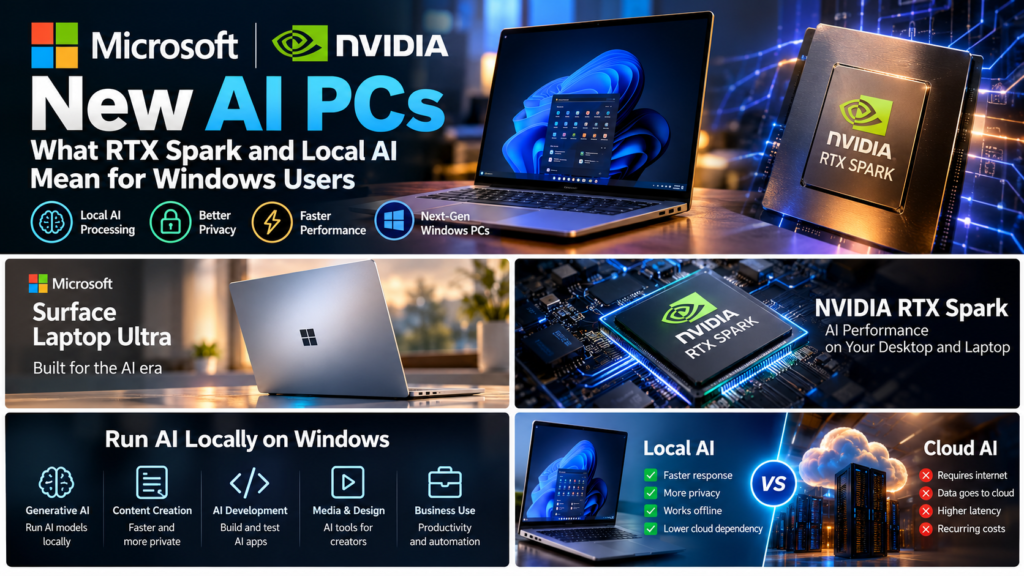
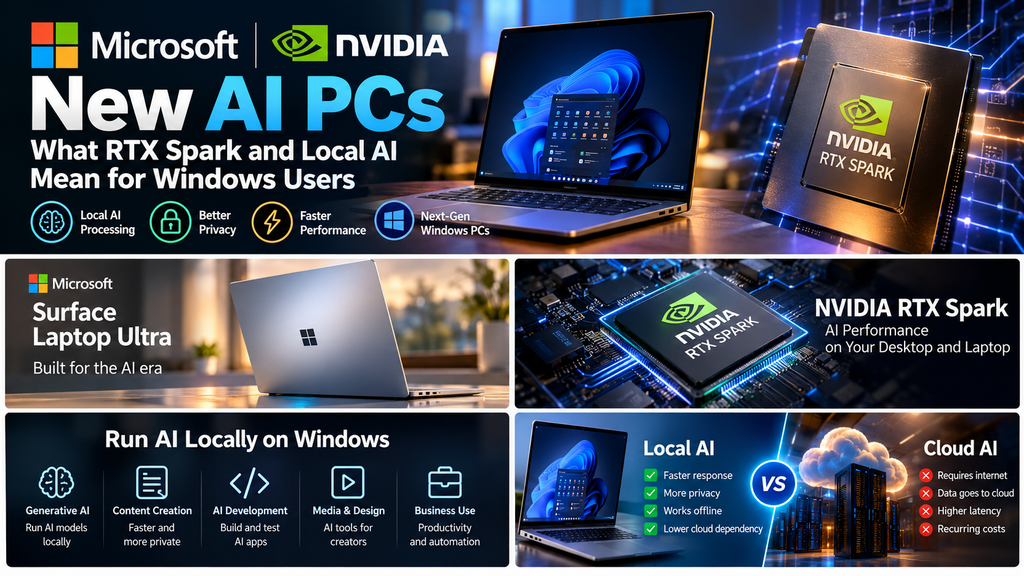
Microsoft and NVIDIA are pushing Windows PCs into a new phase of local AI computing. Their new NVIDIA RTX Spark AI PCs, including the Surface Laptop Ultra, are designed to run more demanding AI models and agents directly on Windows devices. At a San Francisco event on October 7, 2026, the companies also unveiled software and security features aimed at making local AI more practical.
The bigger story is not just a new laptop. Microsoft is betting that future AI PCs will combine local processing, cloud AI and stronger security instead of sending every AI task to a remote data center. That could mean better privacy and lower latency for some workloads, although the hardware needed to run large models locally remains expensive.
What Microsoft and NVIDIA announced
The October 2026 announcements combine new hardware with changes to Windows. Microsoft introduced the Surface Laptop Ultra, powered by NVIDIA RTX Spark, while also highlighting local AI models and new security technology for AI agents. NVIDIA is expanding RTX Spark beyond a single device, with laptops from manufacturers including ASUS, Dell, HP, Lenovo and MSI.
Microsoft says the new Windows approach is built around hybrid intelligence: demanding or sensitive workloads can run locally when suitable, while larger or more complex tasks can still use cloud infrastructure. This is similar to the direction already being taken by modern AI assistants, but the new hardware is designed to make local AI substantially more capable.
NVIDIA RTX Spark AI PCs: What They Actually Offer
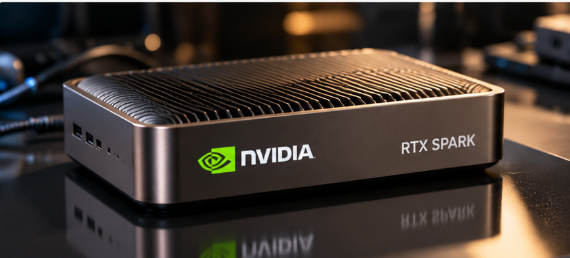
NVIDIA RTX Spark is a new high-performance computing platform aimed at bringing workstation-class AI capability into smaller Windows systems. The Surface Laptop Ultra combines a CPU with a powerful NVIDIA Blackwell-based GPU and a large shared memory pool.
Microsoft’s business configuration lists up to 128GB of unified memory and says the system can provide up to one petaflop of AI compute and run AI models with up to 120 billion parameters locally in supported workloads. Actual performance depends on the model, application, configuration and workload, so these figures should not be treated as a guarantee for every AI application.
Why local AI matters
Most AI services today depend heavily on cloud data centers. Your prompt, document, image or other input is sent to a remote service, processed there and returned to your device. Local AI changes that model by allowing at least some processing to happen directly on the computer.
- Privacy: Sensitive files can potentially stay on the device for supported local workloads.
- Latency: Local processing can reduce the need to send every request over the internet.
- Availability: Some local AI features can continue working when internet connectivity is limited.
- Cost: For organizations running large numbers of repeated AI tasks, shifting suitable workloads away from cloud infrastructure could reduce operating costs.
- Control: Developers and businesses can have more control over which models and data are used.
There is an important limitation: local AI does not mean every AI model can run completely offline. Large models can require enormous memory and computing resources, and many AI services still rely on cloud infrastructure.
Local AI vs cloud AI
| Factor | Local AI | Cloud AI |
|---|---|---|
| Processing | On the PC | Remote data center |
| Privacy | Potentially stronger for supported local workloads | Depends on the service and its data policies |
| Internet requirement | Not always required for local models | Usually required |
| Hardware cost | High-performance hardware can be expensive | Lower device cost, but service fees may apply |
| Model size | Limited by local memory and compute | Can access much larger cloud infrastructure |
| Best use | Private, low-latency and developer workloads | Large models and heavy workloads |
Surface Laptop Ultra explained
The Surface Laptop Ultra is the headline Microsoft device in this new category. It is aimed less at ordinary office users and more at developers, creators and professionals who need substantial local computing power.
The consumer launch price starts at $2,599, while higher configurations can cost considerably more. Microsoft and NVIDIA are therefore positioning this as a premium AI workstation in laptop form rather than a mainstream replacement for an everyday Windows notebook.
Microsoft says the broader RTX Spark laptop family will include models from ASUS, Dell, HP, Lenovo and MSI. These machines are designed for demanding AI workloads, creative applications and high-end gaming rather than basic browsing and office work.
What about AI agents?
One of the more important parts of Microsoft’s announcement is software security. As AI agents become capable of opening files, running commands and completing multi-step tasks, giving an agent unrestricted access to a Windows PC creates new security risks.
Microsoft introduced Microsoft Execution Containers (MXC) as an infrastructure layer designed to give AI agents a controlled environment for executing tasks. The goal is to prevent an agent from accessing data or performing actions outside the permissions assigned to it.
This matters because local AI is useful only if users can trust the software running on their own machines. A powerful AI agent with unrestricted access could become a security problem instead of a productivity tool.
Which AI models can run locally?
Microsoft highlighted local support for models including NVIDIA’s Nemotron family. The company also discussed running a version of DeepSeek V4 locally on sufficiently powerful Windows hardware. Microsoft says Copilot will use a hybrid approach, sending harder tasks to the cloud while delegating suitable workloads to local models when privacy, cost or latency make local processing attractive.
This hybrid approach is likely to become more common. Instead of asking users to choose between a completely offline AI assistant and a cloud-only service, operating systems can decide where a particular task should run.
Who actually needs an RTX Spark AI PC?
For most people, a normal modern laptop will remain enough for web browsing, Microsoft 365, streaming, communication and everyday AI features. If you are comparing AI software rather than hardware, see our guide to choosing AI apps for a practical starting point.
An RTX Spark-class PC makes more sense for:
- AI developers testing and running local models
- Software engineers working with local coding agents
- Creators handling demanding video, 3D and image workloads
- Researchers who need large local models
- Businesses that want more control over sensitive AI workloads
- Power users who want workstation-level performance in a laptop
If you mainly use ChatGPT, Gemini, Copilot, browser apps and office software, buying a very expensive local-AI workstation may not provide enough benefit to justify the price.
Should you buy an AI PC in 2026?
The answer depends on what you want to do with it. The new RTX Spark generation is important because it shows that local AI is moving beyond small AI features such as background blur, webcam effects and basic assistant functions.
However, price is a major barrier. The Surface Laptop Ultra starts at $2,599, and high-end configurations cost much more. Memory is particularly important for local AI, which means buyers should focus on RAM or unified memory, GPU capability, software support and actual model requirements rather than buying a laptop simply because it carries an “AI PC” label.
For an average user, a well-balanced laptop with a modern processor, 16GB or 32GB of memory and good battery life can still be the better choice. Our 2026 laptop buying guide can help with the broader hardware decision. For AI developers and professionals, the extra local compute may be worth the investment.
What this means for future Windows laptops
Microsoft and NVIDIA’s announcement points toward a future where the PC becomes an AI computing device rather than simply a screen for cloud services. Windows will increasingly decide whether a task should run locally or remotely based on performance, privacy, permissions and cost.
That could change how we think about laptop specifications. CPU performance will still matter, but GPU performance, memory capacity and AI software compatibility will become increasingly important when choosing a high-end computer.
Final verdict
RTX Spark is more significant than another laptop launch. It represents a push toward powerful local AI on Windows, while Microsoft’s hybrid approach acknowledges that cloud AI will remain important.
The technology is exciting, but the price means it is not yet a mainstream upgrade for everyone. For developers, creators and businesses working with large AI workloads, however, this generation could make local AI far more practical.
For ordinary Windows users, the best approach is to watch how quickly useful local AI features reach more affordable laptops. The technology is moving fast, and today’s premium AI hardware could become tomorrow’s standard PC capability.