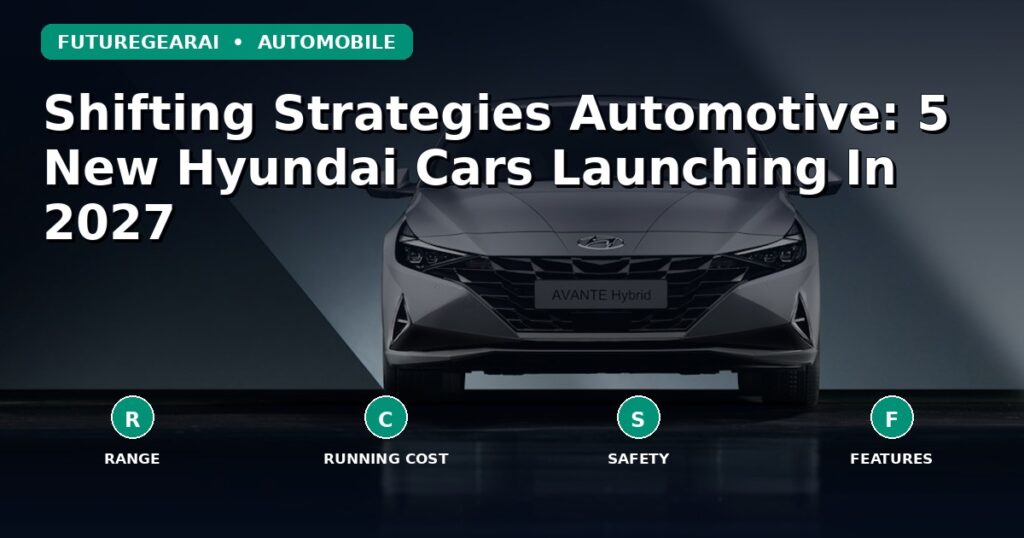
Shifting Strategies Automotive in Hyundai’s Product Roadmap
Shifting Strategies Automotive shapes this review. Automotive product planning moves fast today. Manufacturers balance strict emissions rules with shifting buyer tastes. Hyundai Motor India prepares a large product push. This lineup covers many major powertrain types. It spans traditional engines, alternative fuels like CNG, hybrids, and electric setups [1, 2]. Several models arrive or add variants through 2027 [1]. Buyers face a complex decision matrix.
Understanding this product cycle requires looking beyond teaser campaigns. We must examine platform shifts and powertrain choices. The current market shift toward multi-fuel availability appears in our Indian personal mobility shifts analysis. Choosing a vehicle now means weighing running costs against sticker prices across petrol, hybrid, and CNG setups.
Shifting Strategies Automotive: The Bayon Expansion and CNG Integration
The newly launched Hyundai Bayon sits below the flagship Creta [3]. It measures 4.2 metres in length [3]. The base petrol model debuted at ₹9.99 lakh ex-showroom [3]. It uses a 1.5-litre naturally aspirated MPi engine [3]. This unit makes 115hp and 144Nm of torque [3]. Buyers pick between a six-speed manual gearbox and a CVT [3]. The automatic variant claims an efficiency of 18.6kpl [3].
Hyundai confirmed plans for a factory-fitted CNG variant in January 2027 [1, 3]. This adds a CNG option to the mid-size SUV class [3]. Engineering plans point toward placing the CNG tank beneath the vehicle [1]. This protects usable boot space [1]. Exact specs and power outputs for the CNG version await final factory disclosures [1].
Factory-fitted CNG systems solve a major consumer problem. Traditional aftermarket kits take up the entire trunk. Underfloor or optimized layouts preserve baseline cargo utility. This keeps per-kilometer running costs low compared to standard petrol models.
Practical Trade-offs of Factory-Fitted CNG and Alternative Powertrains
Selecting an alternative fuel vehicle like the upcoming Bayon CNG involves distinct operational compromises. While the lower cost of compressed natural gas relative to standard petrol provides immediate relief at the fuel pump, drivers must account for infrastructure limitations. Refueling queues at public CNG stations can increase travel times, particularly in congested metropolitan corridors. Furthermore, power delivery in CNG mode can experience a slight reduction compared to running on pure petrol, requiring drivers to adjust their overtaking and acceleration habits.
On the other hand, the financial benefits over multi-year ownership cycles remain compelling for high-mileage commuters. Buyers who predominantly use their vehicles for daily urban commutes stand to recover the initial price difference much faster than those with low annual mileage. Assessing local fuel availability before committing to a CNG variant ensures that the theoretical running cost savings translate into practical everyday convenience.
Next-Generation Creta and Hybrid Powertrains
The third-generation Creta is expected around April 2027 [5]. It shifts to the K3 platform shared with the Kia Seltos [5]. Test mules show an upright, boxy exterior silhouette [5]. It features H-shaped LED daytime running lights and a prominent front grille [5]. The grille houses radar sensors for advanced driver assistance systems [5]. Segmented LED taillamps sit at the rear [5].
Cabin layouts receive a major revision. They move toward a minimalist dash design [5]. A large central touchscreen runs Hyundai’s infotainment software [5]. A slim digital driver’s display accompanies it [5]. Higher variants adopt Software Defined Vehicle architecture [5]. This enables over-the-air updates for multiple control units [5].
The 2027 Creta line introduces a strong hybrid powertrain option [5]. It pairs with the existing 1.5-litre non-turbo petrol engine [5]. The hybrid setup uses regenerative braking [5]. This captures energy during deceleration to boost urban fuel efficiency [5]. Traditional petrol, turbo-petrol, and diesel engine choices continue [1].
Strong hybrids offer trade-offs. Urban fuel economy sees large gains over standard petrol models. However, upfront costs rise due to the secondary electric motor, inverter, and battery pack. Buyers must calculate annual mileage thresholds. This determines if fuel savings over a multi-year cycle justify the higher sticker price.
Compact Electric SUV and Platform Shifts
Electrification anchors Hyundai’s roadmap through the HE1i electric SUV [1]. Test sightings suggest a boxy exterior profile [1]. Large windows, an electric sunroof, and a premium cabin complement it [1]. Features include ventilated leather seats, automatic climate control, and ADAS capabilities [1].
The HE1i offers multiple battery pack configurations [1]. Options center around 42kWh, 49kWh, and 51.4kWh [1]. Digital connectivity systems like Plio Connect streamline onboard controls [1]. Comparing these specifications with current market offerings—such as insights on daily electric car running costs—helps determine real-world usability.
Diverse battery capacities help Hyundai segment the EV market. They cater to urban commuters and long-distance drivers alike. Reliance on public charging remains a limitation for buyers without home or workplace chargers. Evaluating local parking space and charging speeds is critical before buying an EV.
Real-World Usability and Limitations of Upcoming Electric Platforms
Deploying battery-electric vehicles like the HE1i introduces new considerations regarding charging infrastructure and daily driving ranges. While the availability of 42kWh, 49kWh, and 51.4kWh battery packs allows buyers to scale their investment according to expected travel patterns, long-distance highway driving requires careful route planning. Public fast-charging stations can significantly reduce waiting times, but home-charging setups remain the most cost-effective and convenient method for daily replenishment. These practical details are useful when evaluating Shifting Strategies Automotive against the reader’s actual needs.
Drivers living in high-rise apartments without designated parking slots or dedicated EV charging access may encounter logistical hurdles. Managing battery thermal performance during peak summer temperatures and understanding how cabin climate control impacts overall driving range are essential skills for new EV owners. Reviewing local utility tariffs and off-peak charging incentives further optimizes the total cost of ownership for battery-electric models.
Refreshed Hatchbacks: i20 and Grand i10 Nios
Volume segments receive generational renewals [1]. The fourth-generation i20 was previewed in Brazil [1]. It features dual-pod pixel LED headlamps and Y-shaped LED DRLs [1]. A full-width LED light bar and a curved dual-screen cockpit house two 10.25-inch displays [1]. Engine options span 1.2-litre petrol and 1.0-litre turbo-petrol units [1].
The next-generation Grand i10 Nios is confirmed for release [1]. It features a new platform with revised exterior and interior designs [1]. Powertrain configurations retain the 1.2-litre petrol engine [1]. Manual and automated manual transmission choices are available [1]. Dedicated CNG and CNG-AMT variants are also planned [1].
Maintaining manual and automated transmissions alongside alternative fuel systems preserves budget choices. The inclusion of CNG-AMT variants removes the fatigue of manual clutch actuation in heavy city traffic. This broadens the appeal of alternative-fuel vehicles to more urban motorists.
What This Means for Buyers
Navigating Hyundai’s release schedule requires aligning habits, fuel pricing, and timelines. Buyers targeting immediate acquisition evaluate current petrol options like the Bayon [1, 3]. Those prioritizing fuel economy may wait for the 2027 hybrid Creta or CNG variants [1, 3, 5].
- Define Your Daily Running Distance: High annual mileage justifies waiting for the Bayon CNG or the Creta hybrid to offset initial vehicle costs.
- Monitor Powertrain Availability: Confirm whether specific safety suites and transmission choices remain tied to top-tier trims.
- Assess Infotainment Preferences: Software-defined architectures mean evaluating whether you prefer physical buttons or touch-centric connected dashboards.
Frequently Asked Questions
When will the next-generation Hyundai Creta hybrid launch in India?
Industry projections and test mule sightings point toward a market debut around April 2027 [5]. It brings updated platform dynamics and improved urban fuel efficiency [5].
Will the upcoming Hyundai Bayon CNG compromise boot space?
Factory integration strategies utilize underfloor or optimized configurations designed to preserve a usable portion of the boot capacity [1].
What battery pack sizes are expected for the HE1i electric SUV?
Preliminary reports indicate the HE1i offers multiple configurations centering around 42kWh, 49kWh, and 51.4kWh capacity options [1].
Prospective buyers should verify exact introductory pricing and variant breakdowns with authorized dealerships as launch dates approach. Ensure selected configurations match local infrastructure and driving requirements.
Sources & further reading
- Hyundai Set to Launch Five Exciting New Models in India — udaipurkiran.com
- 5 Upcoming SUVs expected to launch in India by 2027: New Hyundai Creta to Compact EV — India TV News
- Hyundai Bayon SUV launched at ₹9.99 lakh with generative AI voice assistant; CNG model due in 2027 – CNBC TV18 — CNBCTV18
- Hyundai Bayon Launch Highlights: Price, Specifications, Features, Details — carandbike

