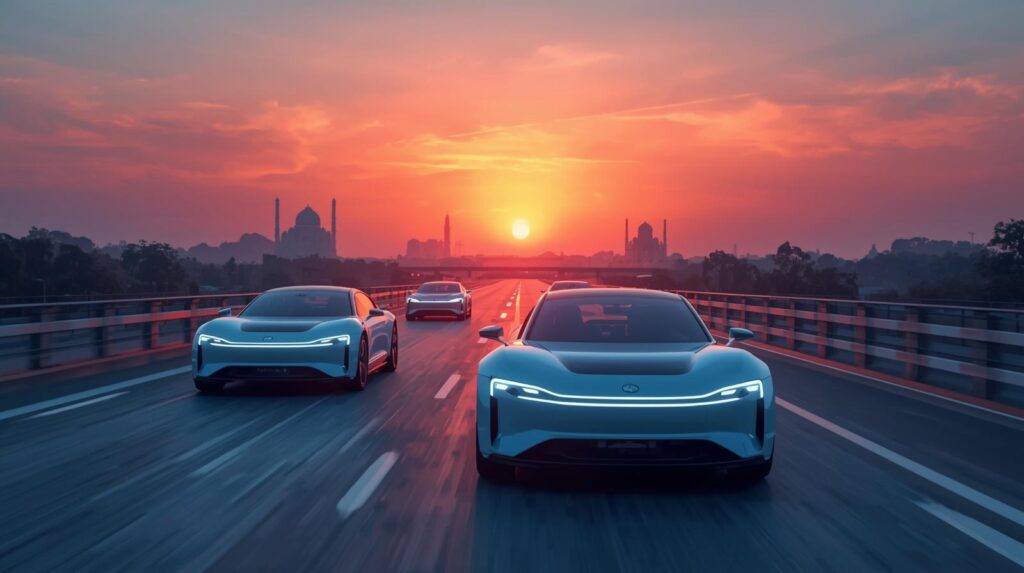
Hydrogen cars in India 2026 are still an emerging technology rather than a mainstream alternative to petrol, diesel or battery-electric cars. Fuel-cell electric vehicles (FCEVs) use hydrogen to generate electricity onboard, while hydrogen internal-combustion vehicles burn hydrogen in an adapted engine. India is now testing both approaches, particularly for buses and trucks, but passenger hydrogen cars still face major infrastructure and cost barriers.
If you are comparing lower-emission options for everyday driving, also read our guides to India’s EV market, charging and ownership trends and choosing between petrol, diesel, CNG, hybrid and electric cars. For CNG buyers, our AMT CNG car buyer’s guide covers another practical alternative available in India.
What Is a Hydrogen Car?
A hydrogen car can use either a fuel cell or a modified internal-combustion engine. In a fuel-cell electric vehicle, compressed hydrogen is stored in high-pressure tanks and fed into a fuel cell. The fuel cell combines hydrogen with oxygen from the air to produce electricity, which powers an electric motor. At the vehicle level, water and heat are the main by-products.
Hydrogen internal-combustion engine vehicles take a different approach: hydrogen is used as a fuel inside an adapted engine. India’s government pilot programme includes both fuel-cell and hydrogen-ICE technologies, allowing real-world comparisons of different approaches.
Hydrogen Cars vs Battery EVs
| Factor | Hydrogen FCEV | Battery EV |
|---|---|---|
| Energy storage | Compressed hydrogen | Battery pack |
| Powertrain | Electric motor | Electric motor |
| Refuelling/charging | Hydrogen station | Charging station |
| Local tailpipe emissions | Water and heat | None |
| Infrastructure in India | Very limited | Growing rapidly |
| Best potential use | High-utilisation and longer-range applications | Most everyday passenger use cases |
Why Is India Testing Hydrogen Vehicles?
India’s National Green Hydrogen Mission is intended to build domestic production, use and infrastructure for green hydrogen. The government has identified transport as one area for pilot projects, particularly where hydrogen could be useful for heavy-duty operations.
In July 2026, the government announced 12 transport pilot projects covering 70 hydrogen-powered vehicles — 27 buses and 43 trucks — across 21 routes, with 16 hydrogen refuelling stations. The projects include both fuel-cell electric and hydrogen internal-combustion vehicles and are designed to collect real-world data on efficiency, fuel consumption, safety and operating costs.
Pune–Mumbai Hydrogen Vehicle Pilot
For Maharashtra, one of the most notable developments is the inclusion of the Pune–Mumbai route in the National Green Hydrogen Mission’s transport pilots. The wider pilot programme also covers routes in Gujarat, Delhi-NCR, Odisha, Jharkhand, Kerala and Andhra Pradesh.
This is important because long-distance routes can help researchers evaluate whether hydrogen can deliver practical range and refuelling advantages for high-utilisation vehicles. It does not mean hydrogen passenger cars are already commercially available across Maharashtra; the projects are still part of technology validation and infrastructure development.
What About Toyota Mirai in India?
India has also moved beyond laboratory testing. In December 2025, the government announced a NISE–Toyota Kirloskar Motor pilot project involving the Toyota Mirai fuel-cell vehicle. The vehicle is being tested on Indian roads as part of efforts to evaluate hydrogen mobility under local operating conditions.
The Mirai is an important technology demonstration, but it should not be confused with a normal retail launch for Indian consumers. Availability of a pilot vehicle does not automatically mean that buyers can purchase and operate one nationwide.
The Biggest Problem: Hydrogen Refuelling Infrastructure
Battery EVs can use home charging, workplace chargers and a growing public charging network. Hydrogen vehicles require dedicated high-pressure refuelling stations, hydrogen storage, transportation and reliable fuel supply.
That makes infrastructure a much bigger hurdle for passenger hydrogen cars. A car can be technically capable of travelling long distances, but it is not practical if the driver cannot find a compatible hydrogen station along the route.
India’s pilot projects are therefore important because they can help establish refuelling infrastructure and provide operating data before larger-scale deployment.
Is Green Hydrogen Really Clean?
A hydrogen vehicle has no conventional tailpipe carbon emissions when a fuel cell converts hydrogen into electricity, but the overall environmental benefit depends on how the hydrogen was produced.
Green hydrogen is produced using renewable electricity, typically through electrolysis. Hydrogen produced using fossil-fuel-based processes can have a much higher lifecycle carbon footprint. For that reason, the source of hydrogen matters as much as the vehicle technology when evaluating its environmental benefits.
How Much Does Hydrogen Fuel Cost?
There is no single nationwide retail hydrogen price that can be used to calculate the running cost of a passenger hydrogen car in India today. Production, compression, transportation, storage and dispensing costs can vary significantly, and many current projects are pilots rather than ordinary retail fuel networks.
The government has been working to reduce green hydrogen production costs and develop domestic manufacturing. In February 2026, the Ministry of New and Renewable Energy reported that green hydrogen prices discovered under government-supported procurement had fallen to ₹279 per kg. However, a procurement or project price should not be treated as the final retail price a private car owner would pay at a future hydrogen station.
Advantages of Hydrogen Cars
- Fast refuelling potential: Hydrogen vehicles can potentially be refuelled much faster than many large battery packs can be charged.
- Long operating range: Hydrogen can be attractive for vehicles that travel long distances or operate for many hours.
- Low local emissions: Fuel-cell vehicles produce water and heat at the vehicle level.
- Useful for heavy transport: Trucks and buses are major areas of India’s current hydrogen pilots.
- Energy diversification: Domestic green hydrogen could eventually reduce dependence on imported fossil fuels in suitable applications.
Disadvantages of Hydrogen Cars
- Very limited refuelling network: Passenger-car adoption cannot scale without stations.
- High system cost: Fuel cells, high-pressure tanks and hydrogen infrastructure remain expensive.
- Hydrogen production matters: Not every kilogram of hydrogen has the same environmental impact.
- Storage is difficult: Hydrogen has low volumetric energy density, so it requires high-pressure storage or other specialised systems.
- Limited consumer choice: Indian buyers have far fewer hydrogen passenger vehicles to choose from than petrol, hybrid or EV models.
When Could Hydrogen Cars Become Practical in India?
There is no reliable date for mass-market hydrogen passenger cars in India. The current evidence points toward a gradual approach: demonstrate the technology in buses and trucks, build refuelling infrastructure, reduce hydrogen and vehicle costs, and then evaluate wider commercial applications.
For private car buyers in 2026, battery EVs are generally the more practical zero-tailpipe-emission option because charging infrastructure and vehicle choices are much more developed. Hydrogen could become more compelling where fast refuelling, long operating hours and high vehicle utilisation outweigh infrastructure costs.
Should You Buy a Hydrogen Car in 2026?
For most Indian private buyers, the answer is not yet. The main limitation is not the fuel-cell technology itself; it is the lack of a widespread hydrogen ecosystem.
If you are buying a car today, compare EVs, hybrids, CNG vehicles and efficient petrol models based on your daily distance, charging or fuel access, purchase budget and running costs. Hydrogen is worth watching, particularly if you are interested in the future of long-distance commercial transport, but it is still an emerging mobility technology for Indian consumers.
Frequently Asked Questions
Are hydrogen cars available in India?
Hydrogen vehicles are being tested in India through government and industry pilot projects. However, widespread retail availability of hydrogen passenger cars and a nationwide refuelling network are not yet established.
Are hydrogen cars better than EVs?
Neither technology is universally better. EVs are currently more practical for most Indian passenger-car buyers because charging infrastructure and model availability are much greater. Hydrogen may have advantages for certain high-utilisation and heavy-duty applications.
Is hydrogen cheaper than petrol?
There is no nationwide retail hydrogen market in India that allows a meaningful petrol-versus-hydrogen comparison for private motorists. Future running costs will depend on hydrogen production, distribution, station and vehicle costs.
Is a hydrogen car an electric car?
A fuel-cell hydrogen car is an electric vehicle because a fuel cell generates electricity to drive an electric motor. It differs from a battery EV mainly in how electricity is stored or produced onboard.
Bottom Line
Hydrogen cars in India are moving from concept demonstrations toward real-world pilot programmes, but the technology is not yet ready to replace battery EVs for everyday private buyers. The most important developments to watch are hydrogen production costs, refuelling stations, commercial vehicle pilots and the performance data generated by routes such as Pune–Mumbai. If those pieces improve, hydrogen could eventually become an important part of India’s low-carbon transport mix.